

Go through this example:Python Code example
Definition
“Composite design pattern composes objects into tree structures to represent part-whole hierarchies. It lets clients treat individual objects and compositions uniformly”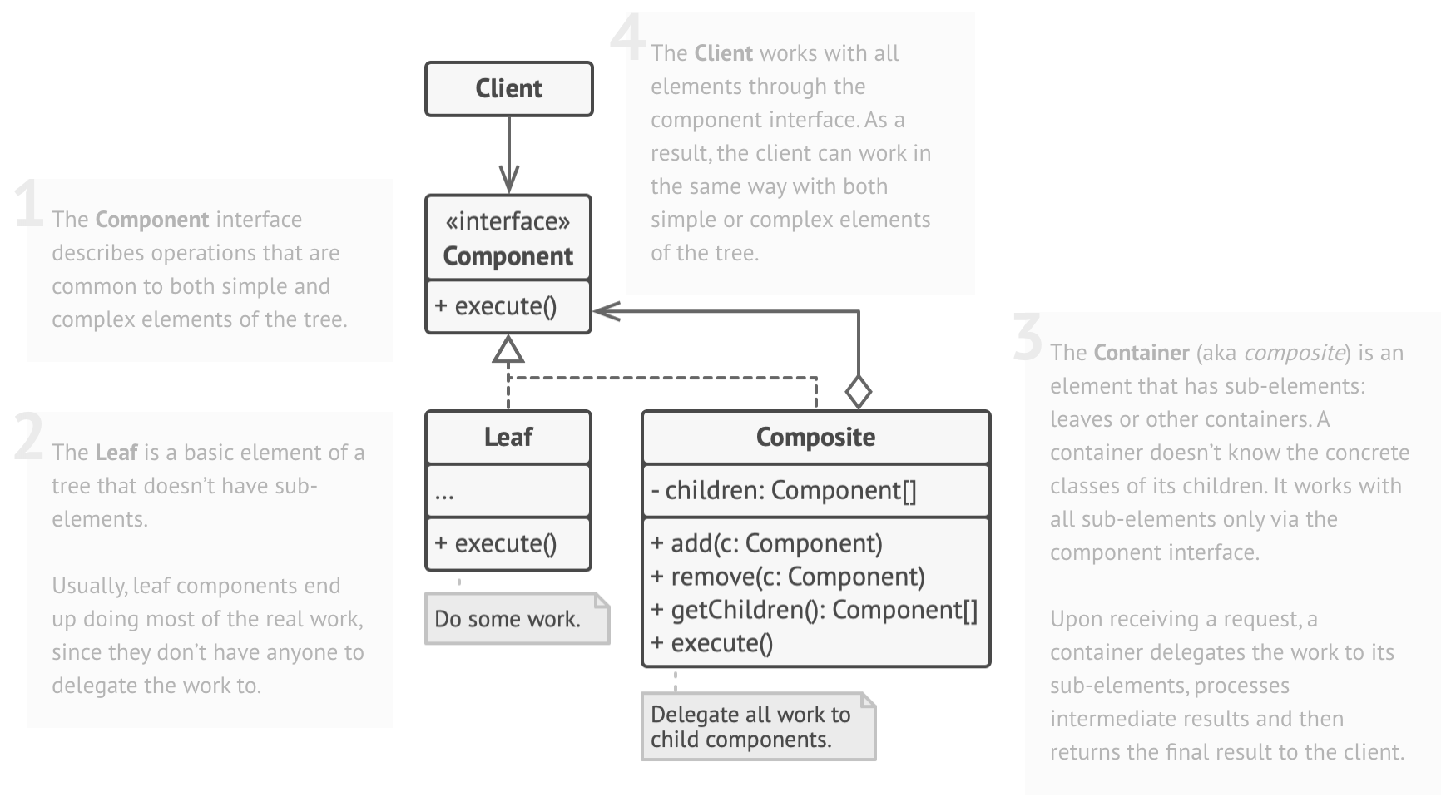
Explanation
You define a Component interface with operations (e.g. render()). Leaf classes implement the interface for indivisible objects (e.g. Circle). The composite class implements the interface and contains a list of Components (both leaves and composites). Methods (e.g. render()) on the composite iterate over children and call their methods. The client interacts with components through the common interface and doesn’t need to know if it’s a leaf or composite.Code
Analogy
An organization chart: an employee (leaf) or a manager (composite) who has subordinates. You can ask any employee or manager to report(), and managers forward the request to their team. Another example: a filesystem: files (leaves) and directories (composites) both respond to open() or list(), with directories delegating to contained files/subdirectories.Interview Insights
Use Case: Represent hierarchical data (graphics scenes, UI components tree, file systems, organizational structures). When clients should treat all objects uniformly.Advantages: Simplifies client code (treat objects & groups the same). Makes it easy to add new kinds of components.
Disadvantages: Can make design too general; components may have to expose child-management methods in interface. Transparent composites can violate Open/Closed: adding a method to all children interface can break leaf classes if not careful.
Common questions:“How do you traverse a composite structure?”, “Difference between Composite and Decorator?”, “What if composites need to support only some operations?”, “How to prevent clients from adding children to leaf nodes?”.\