

Definition
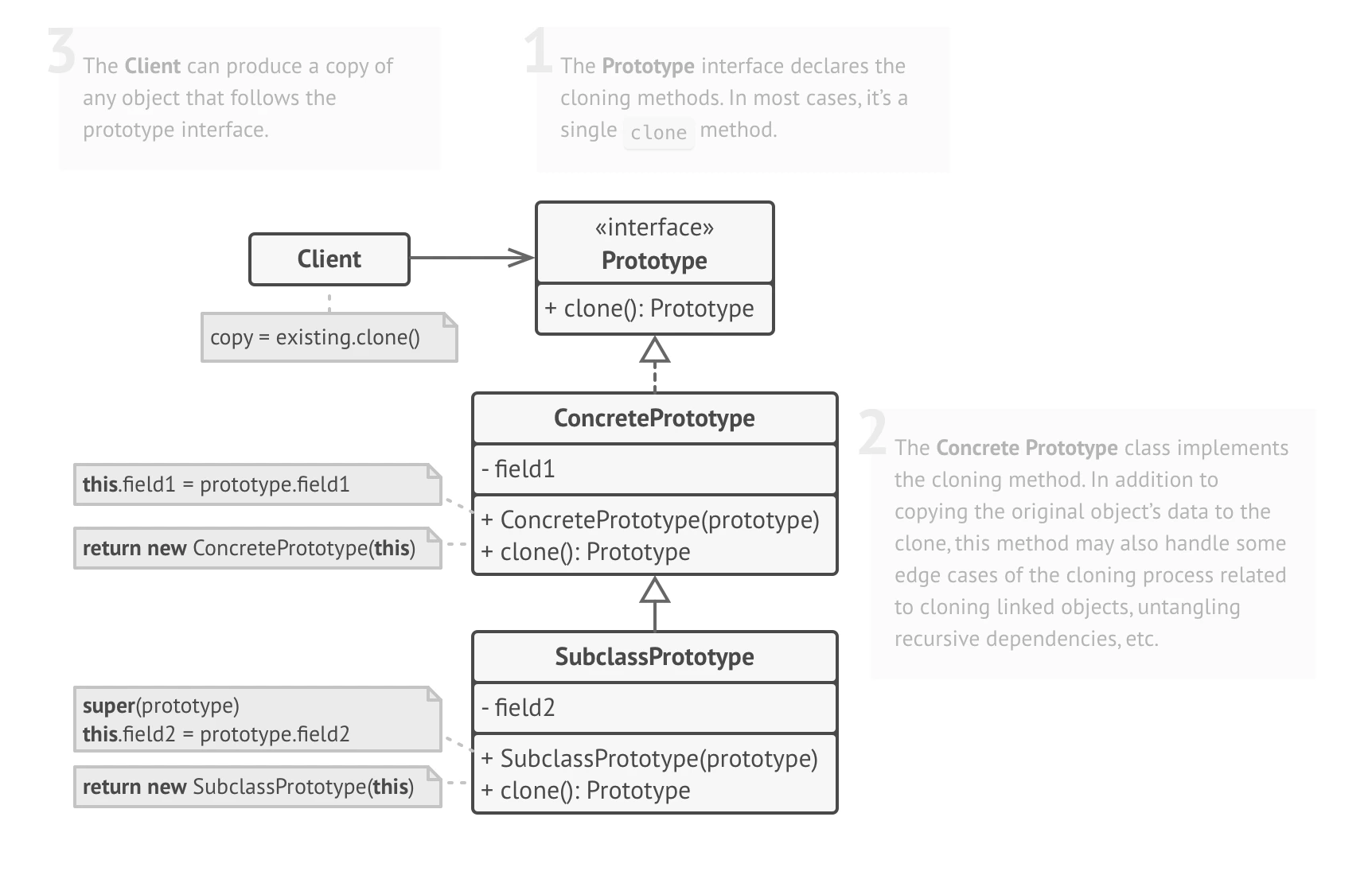
“Prototype pattern lets you produce a copy of an object without knowing anything about its type”In general: specify the kinds of objects to create using a prototypical instance, and create new objects by copying this prototype.
Explanation
You define aclone() method in a class (or an interface) which returns a copy of the object. The client, which may not
know the concrete class, just calls clone() on an existing instance (the prototype) to get a new object. This is useful
when creating a new instance is expensive or when dynamic cloning is needed.
Code
In this example, Creator defines the factory methodfactory_method(), and its subclasses (ConcreteCreator1,
ConcreteCreator2) override this method to create specific products (ConcreteProduct1, ConcreteProduct2). The
client code uses a creator without knowing the exact product class.
Analogy
Photocopier machine: you take an original document (prototype) and make copies. You don’t know the document content, just that you get an exact replica. Or cloning real-world objects, like making a 3D print of an object.Interview Insights
Common uses: When object creation is costly (e.g. heavy initialization) and many similar objects are needed. Also when classes should not be tightly coupled: new objects can be made without knowing class. Used in frameworks with dynamic loading (clone a prototype).Advantages: Adds flexibility by decoupling object creation from classes. Can add or remove prototypes at runtime.
Disadvantages: Cloning complex objects can be tricky (deep vs shallow copy). Can be overused if simple constructors suffice. Prototype registry can become complex.\