> ## Documentation Index
> Fetch the complete documentation index at: https://akshanshgusain.mintlify.site/llms.txt
> Use this file to discover all available pages before exploring further.
# Availability in Distributes Systems
## Availability Patterns
There are two complementary patterns to support high availability: `fail-over` and `replication`.
### Fail-Over
**Active-passive**
With active-passive fail-over, heartbeats are sent between the active and the passive server on standby. If the
heartbeat is interrupted, the passive server takes over the active's IP address and resumes service.
The length of downtime is determined by whether the passive server is already running in 'hot' standby or whether it needs to start up from 'cold' standby. Only the active server handles traffic.
Active-passive failover can also be referred to as master-slave failover.
**Active-active**
In active-active, both servers are managing traffic, spreading the load between them.
If the servers are public-facing, the DNS would need to know about the public IPs of both servers. If the servers are internal-facing, application logic would need to know about both servers.
Active-active failover can also be referred to as master-master failover.
**Disadvantage(s): failover**
Fail-over adds more hardware and additional complexity.
There is a potential for loss of data if the active system fails before any newly written data can be replicated to the
passive.
### Replication
**Master-Slave Replication**
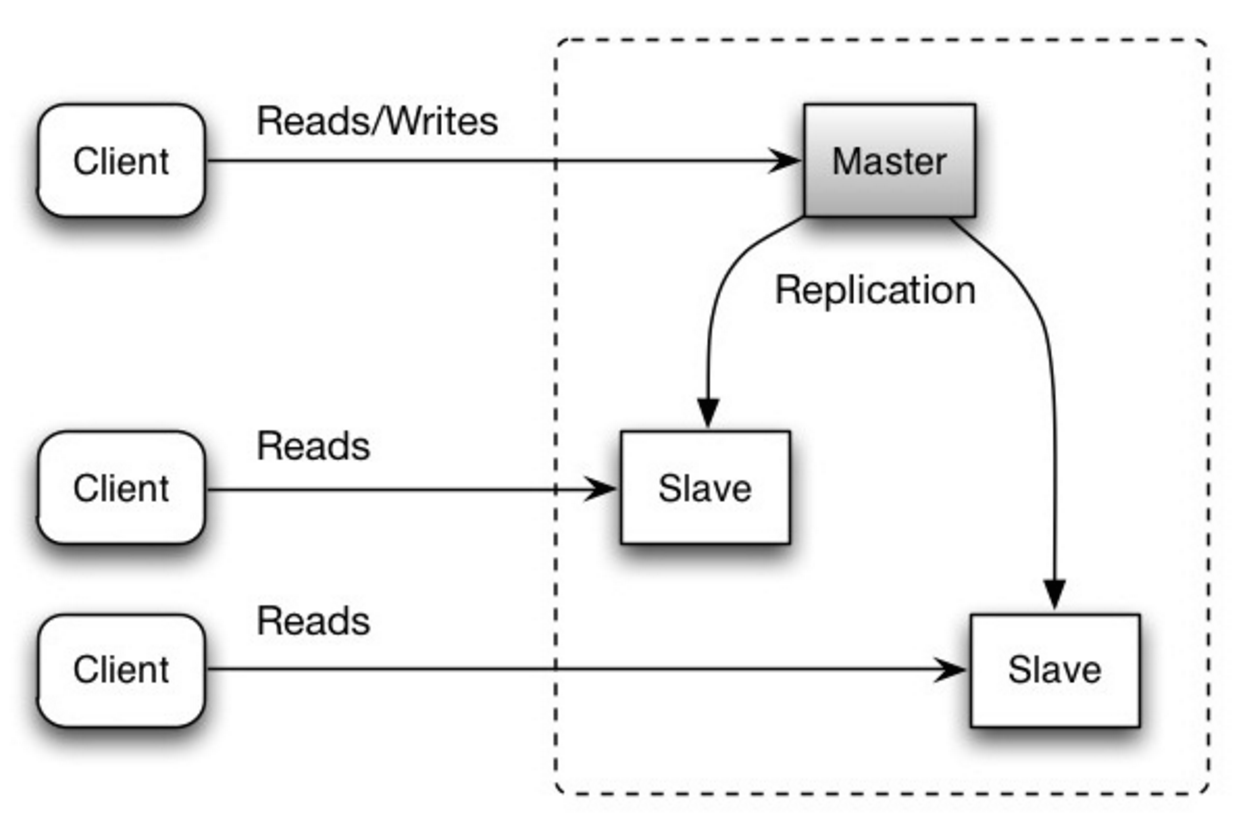
The master serves reads and writes, replicating writes to one or more slaves, which serve only reads. Slaves can also
replicate to additional slaves in a tree-like fashion. If the master goes offline, the system can continue to operate
in read-only mode until a slave is promoted to a master or a new master is provisioned.
 **Master-Master Replication**
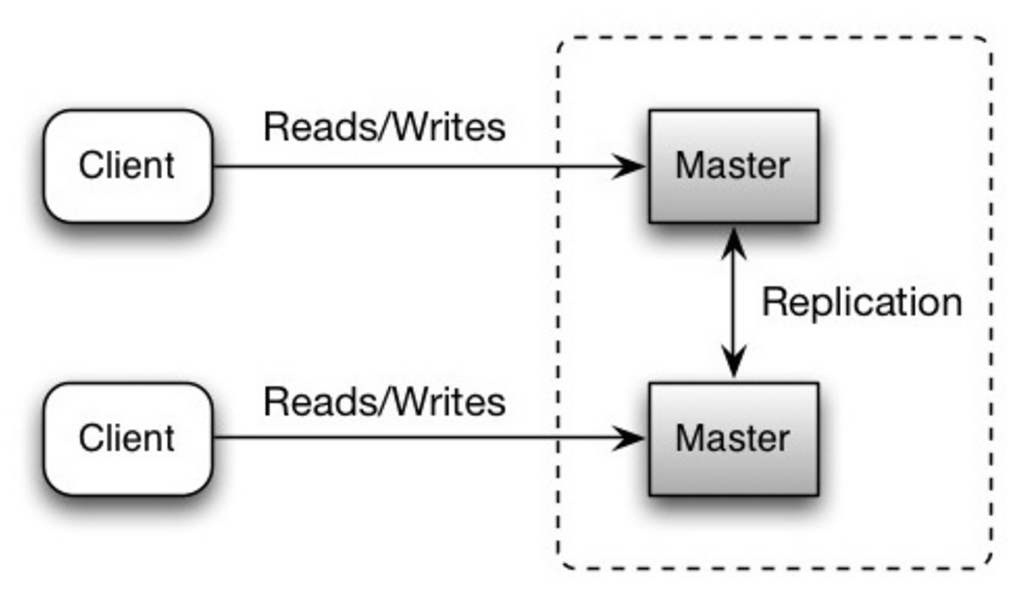
Both masters serve reads and writes and coordinate with each other on writes. If either master goes down, the system can
continue to operate with both reads and writes.
**Master-Master Replication**
Both masters serve reads and writes and coordinate with each other on writes. If either master goes down, the system can
continue to operate with both reads and writes.
 **Disadvantage(s): master-master replication**\\
* You'll need a load balancer or you'll need to make changes to your application logic to determine where to write.
* Most master-master systems are either loosely consistent (violating ACID) or have increased write latency due to synchronization.
* Conflict resolution comes more into play as more write nodes are added and as latency increases.
**Disadvantage(s): replication**\\
* There is a potential for loss of data if the master fails before any newly written data can be replicated to other nodes.
* Writes are replayed to the read replicas. If there are a lot of writes, the read replicas can get bogged down with replaying writes and can't do as many reads.
* The more read slaves, the more you have to replicate, which leads to greater replication lag.
* On some systems, writing to the master can spawn multiple threads to write in parallel, whereas read replicas only support writing sequentially with a single thread.
* Replication adds more hardware and additional complexity.
## Availability Numbers
Availability is often quantified by uptime (or downtime) as a percentage of time the service is available. Availability
is generally measured in number of 9s--a service with 99.99% availability is described as having four 9s.
### 99.9% availability - three 9s
| Duration | Acceptable downtime |
| :----------------- | :------------------- |
| Downtime per year | 8h 45min 57s |
| Downtime per month | 43m 49.7s |
| Downtime per week | 10m 4.8s |
| Downtime per day | 1m 26.4s |
### 99.99% availability - four 9s
| Duration | Acceptable downtime |
| :----------------- | :------------------- |
| Downtime per year | 52min 35.7s |
| Downtime per month | 4m 23s |
| Downtime per week | 1m 5s |
| Downtime per day | 8.6s |
### Availability in parallel vs in sequence
If a service consists of multiple components prone to failure, the service's overall availability depends on whether
the components are in sequence or in parallel.
**In sequence**\
Overall availability decreases when two components with availability \< 100% are in sequence:
`Availability (Total) = Availability (Foo) * Availability (Bar)`\
If both Foo and Bar each had 99.9% availability, their total availability in sequence would be 99.8%.
**In parallel**\
Overall availability increases when two components with availability \< 100% are in parallel:
`Availability (Total) = 1 - (1 - Availability (Foo)) * (1 - Availability (Bar))`\
If both Foo and Bar each had 99.9% availability, their total availability in parallel would be 99.9999%.
**Disadvantage(s): master-master replication**\\
* You'll need a load balancer or you'll need to make changes to your application logic to determine where to write.
* Most master-master systems are either loosely consistent (violating ACID) or have increased write latency due to synchronization.
* Conflict resolution comes more into play as more write nodes are added and as latency increases.
**Disadvantage(s): replication**\\
* There is a potential for loss of data if the master fails before any newly written data can be replicated to other nodes.
* Writes are replayed to the read replicas. If there are a lot of writes, the read replicas can get bogged down with replaying writes and can't do as many reads.
* The more read slaves, the more you have to replicate, which leads to greater replication lag.
* On some systems, writing to the master can spawn multiple threads to write in parallel, whereas read replicas only support writing sequentially with a single thread.
* Replication adds more hardware and additional complexity.
## Availability Numbers
Availability is often quantified by uptime (or downtime) as a percentage of time the service is available. Availability
is generally measured in number of 9s--a service with 99.99% availability is described as having four 9s.
### 99.9% availability - three 9s
| Duration | Acceptable downtime |
| :----------------- | :------------------- |
| Downtime per year | 8h 45min 57s |
| Downtime per month | 43m 49.7s |
| Downtime per week | 10m 4.8s |
| Downtime per day | 1m 26.4s |
### 99.99% availability - four 9s
| Duration | Acceptable downtime |
| :----------------- | :------------------- |
| Downtime per year | 52min 35.7s |
| Downtime per month | 4m 23s |
| Downtime per week | 1m 5s |
| Downtime per day | 8.6s |
### Availability in parallel vs in sequence
If a service consists of multiple components prone to failure, the service's overall availability depends on whether
the components are in sequence or in parallel.
**In sequence**\
Overall availability decreases when two components with availability \< 100% are in sequence:
`Availability (Total) = Availability (Foo) * Availability (Bar)`\
If both Foo and Bar each had 99.9% availability, their total availability in sequence would be 99.8%.
**In parallel**\
Overall availability increases when two components with availability \< 100% are in parallel:
`Availability (Total) = 1 - (1 - Availability (Foo)) * (1 - Availability (Bar))`\
If both Foo and Bar each had 99.9% availability, their total availability in parallel would be 99.9999%.